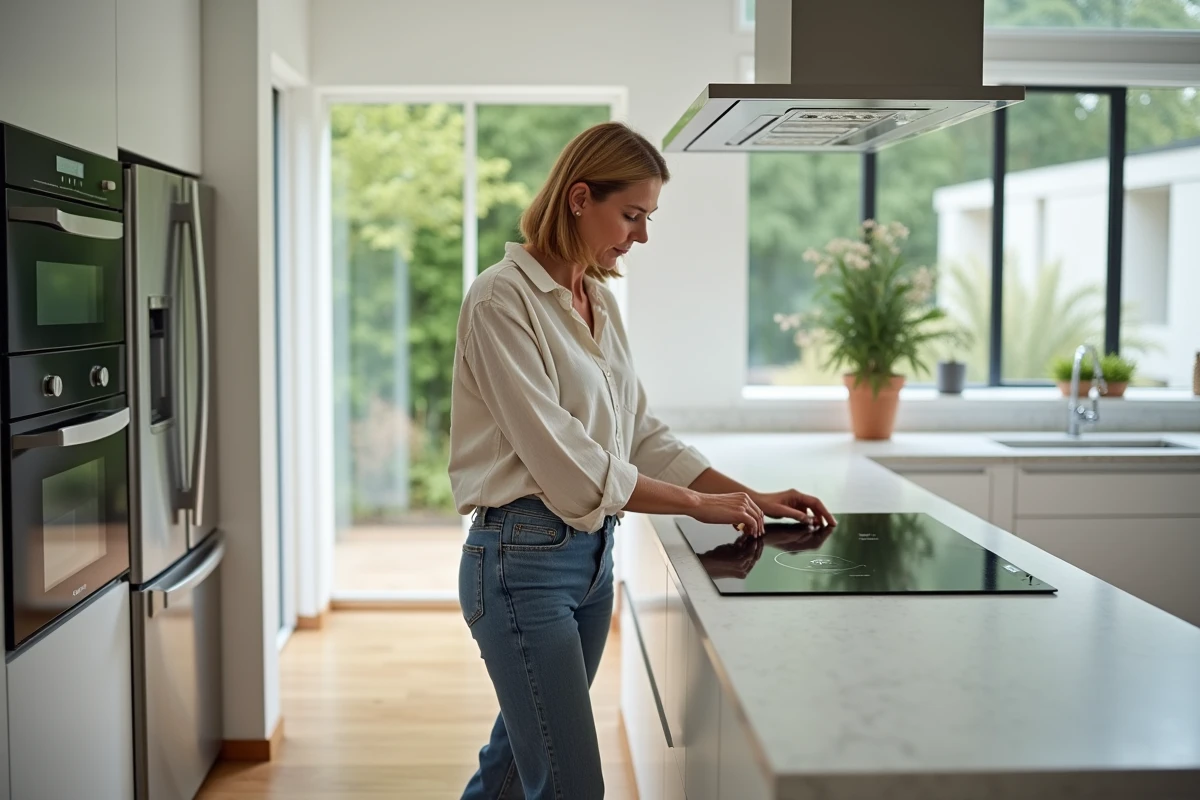
The choice of equipment for a home is not just about ticking off a list of furniture and appliances. Every technical decision, from the ventilation system to the type of heating, affects thermal comfort, air quality, and long-term costs. Here, we discuss the concrete trade-offs that general guides often overlook.
Dual-flow ventilation and indoor air quality: an underestimated trade-off
Ventilation is the neglected aspect of renovation projects. However, we observe that it is the first factor that degrades quality of life when poorly sized: condensation on windows, airborne allergens, and a feeling of suffocation in winter with closed windows.
Since 2025, the installation of hybrid ventilation systems (dual-flow ventilation) has significantly increased in new homes. The ADEME report “Trends in Residential Ventilation 2025” confirms this increased adoption, driven by heightened requirements for indoor air quality following the health crisis. The goal: to reduce the risks of allergies and asthma among occupants.
For an existing home, replacing a single-flow ventilation system with a dual-flow one requires running insulated ducts in the attic or false ceiling. It’s a major project, but the gain in thermal comfort is tangible: the incoming air is preheated by the extracted air, which reduces heating bills. We recommend checking the compatibility of the existing duct network before committing, as undersizing negates the expected benefits.
To delve deeper into selection criteria by type of equipment, specialized resources like the Habitat Guides website allow for comparisons of configurations based on surface area and type of housing.

Collective heating with heat pumps or individual systems: what changes in multifamily housing
In single-family homes, the choice of heating often comes down to a trade-off between air-water heat pumps, pellet stoves, and gas boilers (where still permitted). In condominiums, the question arises differently.
Collective heat pumps outperform individual systems in stable thermal comfort in multifamily housing. Complaints about uneven temperatures between apartments significantly decrease with this type of installation. The advantage comes from pooling: a single properly sized outdoor unit regulates better than a dozen poorly positioned individual units on balconies.
The point of caution remains governance. In condominiums, any replacement of collective heating requires a vote at the general assembly. The initial cost per unit is higher, but maintenance costs are shared. We recommend conducting an independent thermal audit before any collective decision, ensuring that the study includes the sizing of emitters (low-temperature radiators or underfloor heating).
Energy performance diagnosis (DPE) and regulatory constraints on rental equipment
Since decree n° 2024-1123 of October 28, 2024, amending the Climate and Resilience law, the rental ban extends to homes classified E in the DPE starting in 2025, following classes F and G. Landlords of unfurnished rentals must now conduct annual energy audits.
This regulatory constraint has a direct impact on the choice of equipment. Replacing a 1990s electric convector with an inertia radiator does not always suffice to shift a home from class E to class D. One must think in systems:
- The insulation of walls and openings determines the actual efficiency of any heating system, even if it appears effective on paper.
- The production of domestic hot water weighs heavily in the DPE calculation: a thermodynamic water heater can single-handedly elevate a class in certain configurations.
- Ventilation is included in the calculation: a dual-flow ventilation system improves the score, while the absence of mechanical ventilation degrades it.
Before investing in isolated equipment, we recommend simulating the impact on the DPE with a certified diagnostician. A poorly targeted investment (changing heating without addressing insulation) represents an expense without regulatory results.

Voice-controlled home automation and accessibility for people with reduced mobility: a concrete lever for autonomy
The accessibility of a home for people with reduced mobility is not limited to door width and countertop height standards. Field feedback shows that voice-controlled home automation significantly reduces daily physical efforts. The ANCRE study “User Experiences for People with Reduced Mobility in Connected Housing” from February 2026 reports a reduction in physical efforts of 30 to 50% thanks to integrated voice assistants like Google Home or Alexa.
Specifically, controlling roller shutters, lighting, the thermostat, and connected outlets by voice eliminates dozens of movements and manipulations each day. For people with reduced mobility, this is a gain in autonomy that far exceeds mere comfort.
A common pitfall: multiplying incompatible ecosystems. A home equipped with Somfy shutters, Philips Hue bulbs, and a Netatmo thermostat requires a unified gateway to operate frictionlessly with voice commands. Prioritizing an open protocol (Matter, Zigbee) from the outset prevents being locked into a single manufacturer.
Integrated storage and kitchen layout: the aspects that change daily use
A home can have excellent technical equipment and still be uncomfortable to live in if functional layout is neglected. Integrated storage, often seen as a secondary aspect, determines a space’s ability to remain organized without constant effort.
In the kitchen, the choice of equipment goes beyond the brand of the oven or refrigerator. The depth of base cabinets, the height of the countertop, the positioning of the dishwasher relative to the sink: these ergonomic details condition usability comfort over the years. A countertop that is just a few centimeters too low can lead to chronic back pain.
For the rest of the home, modular storage solutions outperform fixed furniture in adaptability. A wardrobe with adjustable rails adapts to a change in wardrobe or family composition, whereas a fixed closet imposes its constraints.
The choice of equipment for a home hinges on the coherence between technical aspects (ventilation, heating, insulation) and the functional layouts of daily life. A home where the ventilation system is properly sized, the heating is suited to the structure, and the storage is designed for actual use offers a comfort that the accumulation of poorly coordinated high-end devices will never provide.