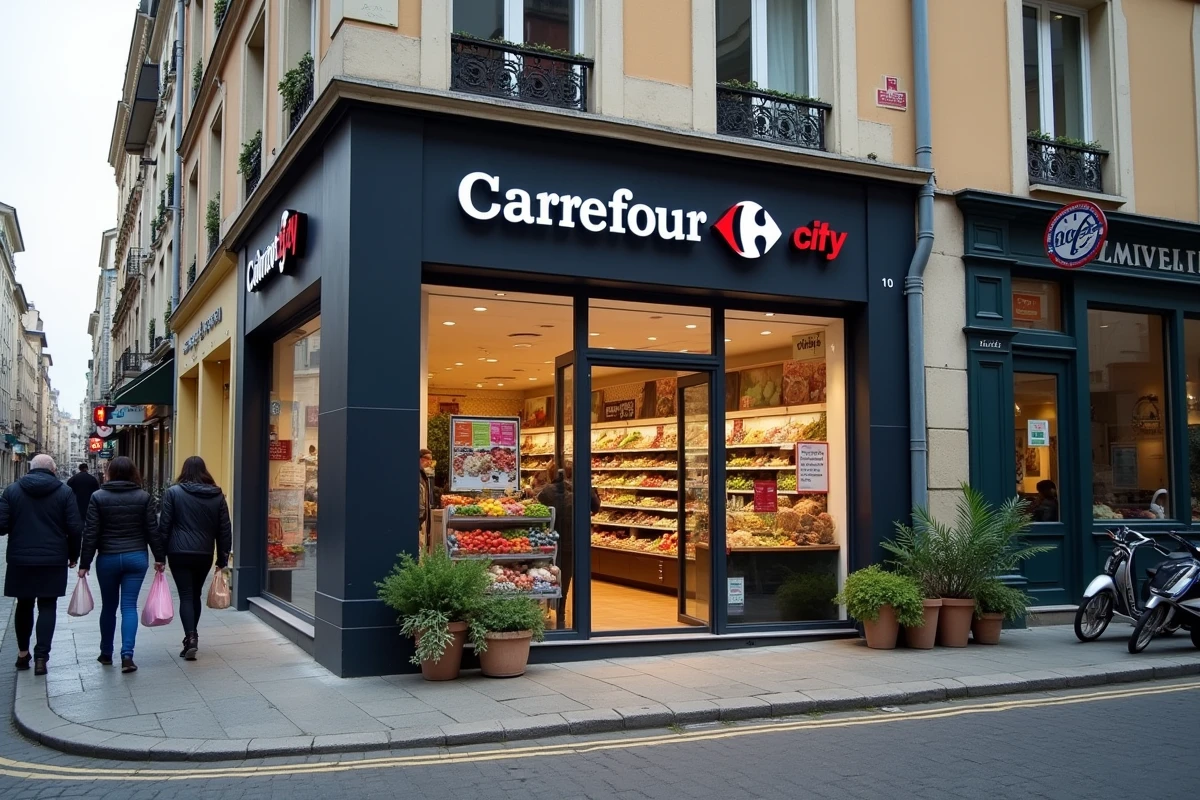
You push open the door of a Carrefour City at 10 PM to buy milk and sandwich bread, and the next day you fill an entire cart at a Carrefour Market on the outskirts. Both carry the same logo, but the shopping experience, prices, and selection on the shelves have little in common.
Hours and late-night convenience: the real daily divide
The most common reflex when entering a Carrefour City is to check the time. These downtown stores rely on very broad operating hours. A Carrefour City in Paris, on Avenue de la Motte-Picquet, operates almost continuously, with nighttime openings noted in customer reviews.
A Carrefour Market has much more traditional hours. In Taverny, in the Paris region, the store opens from 8:30 AM to 8:30 PM or 9 PM. This pattern is found in most suburban Markets.
Specifically, the City serves as a late-night convenience store, while the Market covers weekly shopping during the day. If you’re looking for a store open after 9 PM, the answer is almost always a City. To understand the difference between Carrefour City and Carrefour Market, it’s primarily this time gap that matters.
Carrefour Market in the suburbs: a medium-sized supermarket
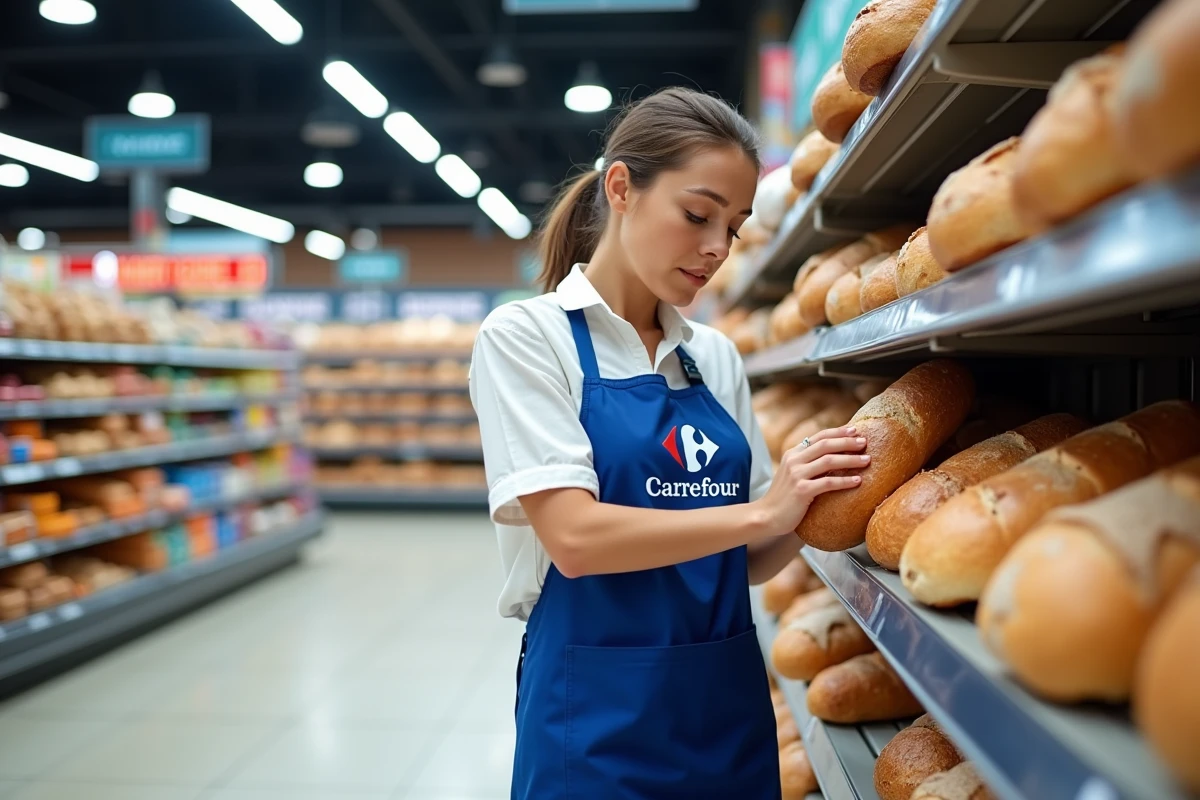
The Market format remains Carrefour’s standard for suburban areas and city entrances. In 2026, a new Carrefour Market was authorized along the RD113 in Saint-Aunès, in Hérault, replacing an old competing supermarket. This type of takeover illustrates the group’s strategy: to establish Markets where space and traffic flow allow for a wide assortment.
In a Market, you’ll find butcher, fishmonger, cheese counter, an extensive organic section, and often a catering space. The assortment of a Market is similar to that of a small hypermarket, with several thousand food and non-food references.
What you won’t find in a City
The Carrefour City, on the other hand, operates in a reduced space, right in the city center. The fresh produce section exists, but is self-service only. No cut-to-order, no seasonal bazaar section, no appliances. The offering is focused on everyday products: groceries, beverages, hygiene, frozen foods, and a few fruits and vegetables.
- Market: cut-to-order sections (butchery, cheese), wide selection of fresh and non-food products, dedicated parking
- City: self-service only, assortment focused on convenience and quick meals, pedestrian access in the city center
- Hours: the City opens early and closes late (sometimes 24/7 in big cities), the Market follows classic supermarket hours
Price positioning: gaps not to be underestimated
One might think that the common logo guarantees aligned prices. Feedback varies on this point, but a clear trend emerges. In 2026, UFC-Que Choisir ranks Carrefour group brands, including Carrefour Market, among the “significantly more expensive” compared to hard discounters and some integrated competitors.
The City charges prices that are even higher than those of the Market, which makes sense: reduced space, city center rent, extended hours. The extra cost is reflected in the receipt. For a weekly shopping basket, the bill in a City can be significantly higher than in a Market, and the comparison with an Intermarché or a Leclerc further widens the gap.
When price takes a back seat
This extra cost does not disqualify the City, however. Buying a carton of milk at 10:30 PM right by your home has a value that price alone does not capture. The City sells time and proximity, not price competitiveness. If your priority remains the budget, the Market or a classic Carrefour hypermarket will be more suitable.

Franchise and management: two distinct operating models
The majority of Carrefour City stores operate as franchises. An independent operator manages their store, inventory, hours, and team under the Carrefour brand. This model explains the variability from one City to another: some are impeccable, while others are less well-stocked.
Carrefour Markets can be operated as franchises or integrated (managed directly by the group). An integrated Market benefits from the group’s centralized logistics, which often results in less frequent stockouts and a more marked consistency in range.
- City as a franchise: the manager adapts their hours and assortment to local habits, with a personal investment required to start the business
- Integrated Market: centralized management, commercial policy dictated by headquarters, national promotions systematically relayed
- Franchise Market: hybrid operation, the franchisee follows the group’s standards while retaining some leeway in daily management
Carrefour Express and other formats: where is the boundary
The Carrefour group also operates Carrefour Express stores, which are even smaller than the City. These micro-stores target train stations, gas stations, and very dense neighborhoods. The assortment is limited to a few hundred references, with a focus on snacking and beverages.
Between Express, City, Market, and hypermarket, each format responds to a specific shopping moment. The Express for urgent mobility, the City for daily urban convenience, the Market for weekly shopping, and the hypermarket for large volumes and non-food items.
Choosing the right format therefore depends less on the brand than on the situation. Before comparing prices or ranges, the first question to ask remains simple: are we shopping for tonight or for the week?